


On top of a mountain in beautiful Monroe County, there’s a farm where mornings start early, boots stay dusty, and life revolves around faith, family, and a flock of sheep with fluffy legs groomed to perfection.
Welcome to Angel Mountain Farm. For the Moser family, this life isn’t about convenience. It’s about calling. Pete and Heather Moser, along with their children Anna Lynn, Christine, Elizabeth Paige, and little Pete Moser Ill, better known as “Bubba”, have built a life deeply rooted in togetherness, hard work, and learning to trust God one season at a time.
From homeschooling and homesteading to showing sheep across the region through 4H, their days are full, messy, meaningful, and beautifully their own. “He tends his flock like a shepherd: He gathers the lambs in His arms and carries them close to His heart.” – Isaiah 40:11. That verse feels fitting for a family like the Mosers, because everything they do seems centered around care. Caring for their animals. Caring for each other. Caring for the life they believe God led them toward.
Heather and Pete settled down in his hometown, planting roots high above the valleys below on the mountaintop property that would later inspire the name Angel Mountain Farm. And while they may describe themselves as “just getting started,” their story already feels rich with purpose.
Their farm is alive with gardens, canned goods lining shelves, freeze-dried foods being prepared for market, sheep moving through the barn, and children learning lessons many adults never experience. The family homeschools together, works together, travels together, and shows sheep together. And they absolutely love it.
Halters, Haircuts, and Hard Work
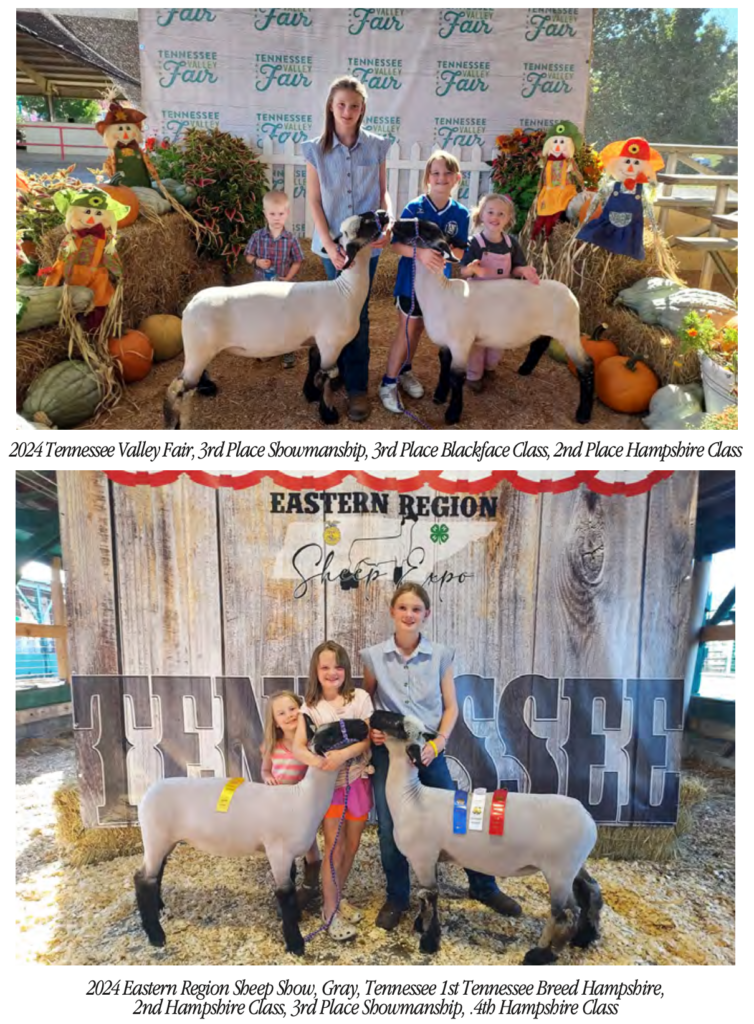
What began with just two sheep has quickly grown into something much bigger at Angel Mountain Farm. Today, Anna and Christine are showing ten sheep between them, traveling across the region during show season and immersing themselves in a world that most people never fully realize exists. Because showing sheep is far more than simply walking an animal around a ring.
“There’s way more to learn than people think,” the family noted. The process begins long before the first competition. When
a new lamb arrives at the farm, it usually has never worn a halter, walked in a show ring, or learned how to stand properly for a judge. The sheep don’t automatically know what to do, and neither do the kids at first. They learn together.
Every animal has a completely different personality. Some are stubborn and strong- willed. Some are nervous. Some naturally carry themselves like champions from day one. Others require weeks and weeks of patience and repetition. That means early mornings, evening practices, and countless laps around the barn learning how to walk correctly beside the sheep while gently guiding them, eventually without a halter. The kids teach the lambs to brace their legs properly, hold their heads correctly, and remain calm in loud, busy show environments filled with people, lights, noise, and pressure.
And somewhere along the way, those lambs stop feeling like livestock and start feeling like teammates. Then comes the grooming process, an art form entirely its own. At sheep shows, presentation matters. The family carefully washes, trims, and shears each animal with incredible attention to detail. The fluffy hair left on the legs, called shag, must be sculpted just right, especially for the curly-headed Hampshire and Southdown breeds the family loves to show.
“It’s kind of like a beauty contest for sheep,” they joked. But behind the polished appearance is hours of work most people never see.
The family studies bloodlines, structure, movement, muscle tone, feeding programs, and daily care routines. They monitor how each sheep grows and develops, adjusting feed and conditioning along the way. And because the animals depend entirely on them, the responsibility never pauses.
“You wake up in the morning and you have to go feed,” Bubba explained. “You have to make sure they are taken care of 24/7.”
By the time show day finally arrives, emotions run high. The mornings start early with final grooming, touch-ups, loading trailers, gathering supplies, and making sure every sheep is ready for the ring. Then comes the anticipation waiting outside the arena gates, the nervous energy, the excitement, the adrenaline, and the quiet pep talks between family members.
And once the kids step into the ring, it’s all on them. The judges watch everything. How the sheep walks. How it stands. How the child handles pressure. How confidently they present themselves and their animal. For Anna, now entering her third year showing sheep, that experience has transformed her confidence completely. “I love being with my family doing sheep shows,” she shared. “It has built my confidence. I have overcome stage fright.” At first, entering the ring felt intimidating. “This is easier than I thought,” she said with a smile. “I just imagine the judge is someone I know.”
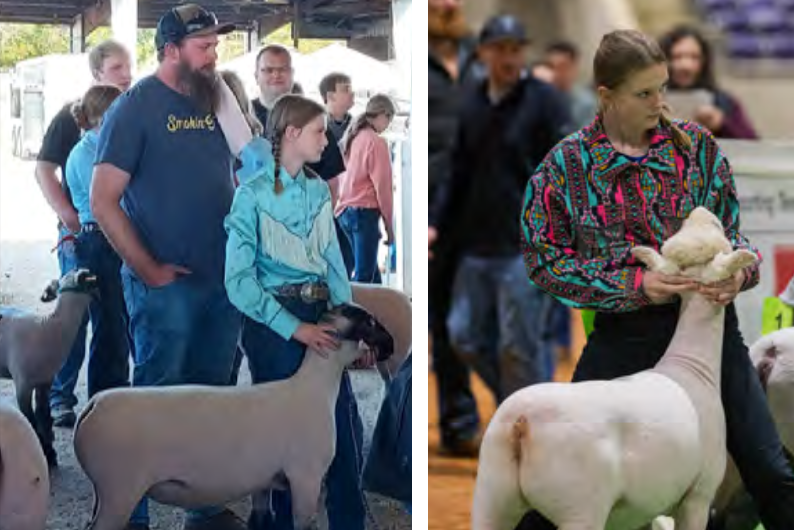
But even experienced showmen have difficult moments. “Sometimes the animals don’t want to do what I want it to do,” Anna explained, “but I just have to take a deep breath and go with it.” That lesson proved especially true during the Anderson County Fair last year when one of Christine’s sheep broke loose during competition. Instead of panicking, she stayed calm, regained control, and continued showing, ultimately earning third place. Moments like that become bigger than ribbons. They become life lessons.
For the Moser family, 4-H has become about far more than sheep. It has become a classroom, a community, and a place where their children are learning skills that will carry far beyond the show ring. Everyone contributes. Everyone helps. Everyone learns. While sheep showing may have first drawn them in, the lessons have reached far beyond the barn. Through 4-H, the kids are learning responsibility, discipline, teamwork, sportsmanship, public speaking, and confidence in ways that feel natural and hands-on.
That includes livestock judging, something Anna and Christine have also begun pursuing. Twice a week, they practice evaluating animals and preparing verbal reasoning for why one animal should place over another in competition. It’s not just about agriculture, it’s about learning how to think critically, communicate clearly, and make confident decisions under pressure.
For the girls, those lessons have been life changing. And Heather hopes more families realize opportunities like this exist. Whether it’s livestock projects, judging competitions, classroom presentations, or creative projects, she believes 4-H helps shape children long after the ribbons are packed away.
Christine is now stepping into her own 4-H journey as well. Although she has previously participated in state fairs, this will be her first official year showing sheep through 4-H competition. “I am so excited to be able to show this year,” she shared, “and look forward to earning a buckle of my own.” And there are already plenty of banners hanging around the barn and buckles on the shelves.
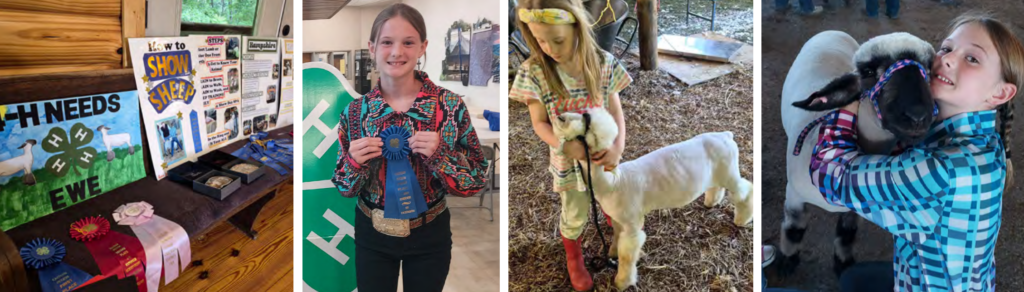
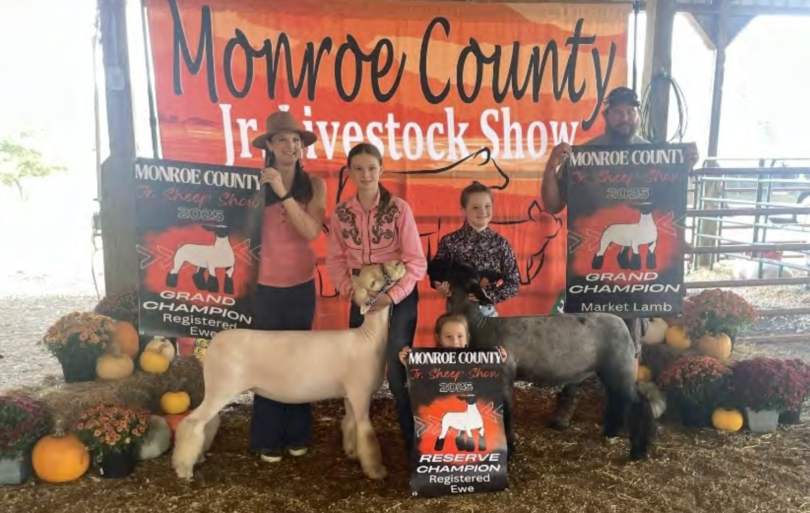
The family has earned multiple first-place ribbons, championship buckles, and regional honors through their sheep projects and 4-H involvement, including Monroe County Grand Champion Market Lamb and Grand Champion Registered Ewe in 2025, Reserve Champion Hampshire at the Anderson County Fair, Monroe County Outstanding Junior 4-H’er 2024, and acceptance into the 2026 4-H Academic Conference.
But while many of the awards officially belong to Anna, the family sees every ribbon, buckle, and banner as something earned together.
Because on Angel Mountain Farm, no one succeeds alone. Behind every sheep stands an entire family working side-by-side, feeding, grooming, encouraging, practicing, loading trailers, cheering each other on, and building memories together one show at a time.
And perhaps what makes Angel Mountain Farm so special is that they are still at the beginning. The family is beginning to focus on breeding their own sheep, Because in the livestock world, the cycle never really stops. Wethers, or castrated males, can only be shown for one year, while ewes can typically be shown for two years before becoming mothers themselves, creating a constant rotation of sheep on the farm.
Alongside the sheep, the family continues building a life centered around faith, learning, and self-sufficiency. Gardens are planted and harvested together. Foods are canned and preserved. New freeze-dried products are beginning to make their way into local markets. And while no one knows exactly where those ventures may lead, the family is excited to see what doors God may open next. Heather, especially, feels called to help others along the way.
Through her homeschooling and 4-H outreach, Heather encourages mothers who may feel overwhelmed or intimidated by taking an unconventional path. Through her Facebook page, she has created a welcoming community space where families can ask questions, learn more about homeschooling and 4-H opportunities, and feel supported as they begin their own journeys. She understands what it feels like to step into something unfamiliar, and she hopes Angel Mountain Farm can serve as proof that families do not have to have everything figured out to begin.
Sometimes faith simply looks like taking the next step. For the Mosers, this life is not about perfection. It is about purpose.
It is about raising children who know how to work hard, care deeply, trust God, and stay connected to one another. And somewhere between the halters, haircuts, early mornings, and long show days, they are building something far more meaningful than a collection of ribbons. They are building a life their children will remember forever.One sheep. One show. One season. One faithful step at a time.